
Plywood Thickness Chart
A “3/4-inch” sheet of plywood usually measures 23/32 inch — enough difference to matter for dadoes, grooves and hardware. This chart lists nominal and actual thicknesses, metric equivalents and typical uses, and the finder estimates sheet weight and how many sheets a job needs.
- Instant download
- Editable Word
- Print-ready PDF
- 7-day refund
Quick answer
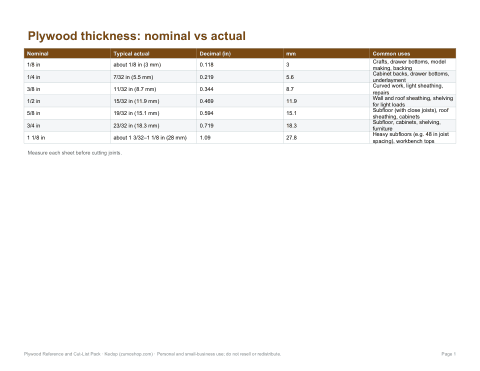
1/2 in plywood actual thickness is usually 15/32 in, or 0.469 in (11.9 mm). A plywood thickness chart matters because nominal sizes are often about 1/32 in thinner than labeled. For cabinets, 3/4 in (often 23/32 in) is common; for wall or roof sheathing, use the panel’s stamped span rating and local code.
5 files · PDF, DOCX
Plywood Reference and Cut-List Pack
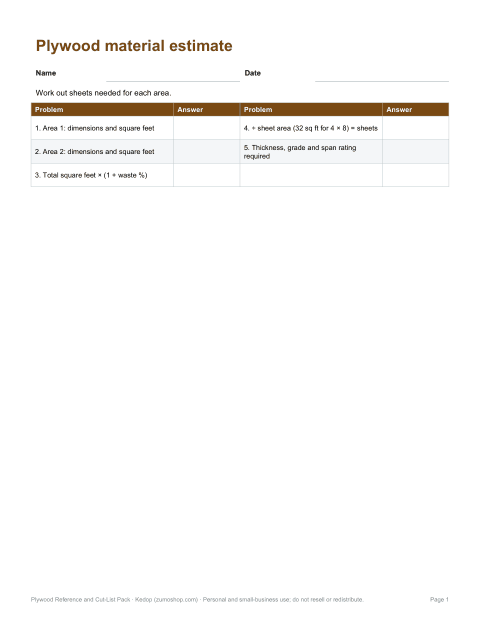
Printable plywood thickness chart, a metric-to-imperial conversion card, a sheet weight table, a cut-list and sheet layout template and a material estimate worksheet.
- Thickness chart (PDF/DOCX)
- Metric card (PDF/DOCX)
- Weight table (PDF/DOCX)
- + 2 more
$5.00 USD, one-time 5 files · about $1.00 each
- Instant download
- 7-day refund
- Secure checkout by Stripe
7-day money-back guarantee. Full refund within 7 days of purchase, even after you download.
Free sample: Plywood Thickness Chart (PDF, 60 KB)
Plywood Reference and Cut-List Pack
Printable plywood thickness chart, a metric-to-imperial conversion card, a sheet weight table, a cut-list and sheet layout template and a material estimate worksheet.
- Thickness chart (PDF/DOCX)
- Metric card (PDF/DOCX)
- Weight table (PDF/DOCX)
- Cut list & layout (PDF)
- Estimate worksheet (PDF/DOCX)
Formats: PDF, DOCX. Instant download after payment (link valid 72 hours, up to 5 downloads). AI-assisted: the templates were drafted with AI help and reviewed and laid out before publishing.
$5.00 USD, one-time 5 files · about $1.00 each
- Instant download
- 7-day refund
- Secure checkout by Stripe
7-day money-back guarantee. Full refund within 7 days of purchase, even after you download.
Free sample: Plywood Thickness Chart (PDF, 60 KB)
Full refund within 7 days — see the refund policy and license.
Free printables
Single sheets you can print right now, no sign-up. The full pack adds every sheet in one download plus the editable files.
 Printable Plywood Thickness Chart
 Printable Metric Plywood Thickness Chart
 Printable Plywood Weight Table
 Printable Plywood Cut List Chart
 Printable Plywood Estimate Worksheet
Use the plywood thickness chart
Plywood Thickness Chart: Nominal vs Actual
Actual sizes are typical; measure your sheet before cutting dados, grooves or fitted parts.
| Nominal | Typical actual | Decimal / mm | Common use or note |
|---|---|---|---|
| 1/8 in | 3 mm or 1/8 in | 0.118–0.125 / 3.0–3.2 | Crafts, backs |
| 1/4 in | 7/32 in | 0.219 / 5.6 | Drawer bottoms, cabinet backs |
| 3/8 in | 11/32 in | 0.344 / 8.7 | Light sheathing, curves |
| 1/2 in | 15/32 in | 0.469 / 11.9 | Wall/roof sheathing; check stamp |
| 5/8 in | 19/32 in | 0.594 / 15.1 | Subfloor or roof; check stamp |
| 3/4 in | 23/32 in | 0.719 / 18.3 | Cabinets, subfloor, shelves |
| 1 1/8 in | 1 3/32–1 1/8 in | 1.094–1.125 / 27.8–28.6 | Heavy subfloor panels |
What’s in the pack
- Printable plywood thickness chart (nominal, actual, mm)
- Metric-to-imperial plywood conversion card
- Sheet weight table for common panel types and sizes
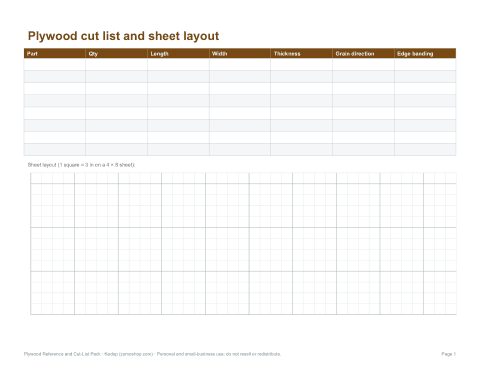
- Plywood cut-list and sheet layout template
- Material estimate worksheet for floors, walls and roofs
Print the chart for the workshop wall or take it to the lumber yard.
US plywood: nominal vs actual thickness
| Nominal | Typical actual | Decimal (in) | Common uses |
|---|---|---|---|
| 1/8 in | about 1/8 in (3 mm) | 0.118 | Crafts, drawer bottoms, model making, backing |
| 1/4 in | 7/32 in (5.5 mm) | 0.219 | Cabinet backs, drawer bottoms, underlayment |
| 3/8 in | 11/32 in (8.7 mm) | 0.344 | Curved work, light sheathing, repairs |
| 1/2 in | 15/32 in (11.9 mm) | 0.469 | Wall and roof sheathing, shelving for light loads |
| 5/8 in | 19/32 in (15.1 mm) | 0.594 | Subfloor (with close joists), roof sheathing, cabinets |
| 3/4 in | 23/32 in (18.3 mm) | 0.719 | Subfloor, cabinets, shelving, furniture |
| 1 1/8 in | about 1 3/32–1 1/8 in (28 mm) | 1.094 | Heavy subfloors (e.g. 48 in joist spacing), workbench tops |
Most US construction and cabinet plywood is sold under a nominal size and made about 1/32 inch thinner. Hardwood plywood and imported panels are often closer to metric sizes — 3/4-inch hardwood plywood may measure 18 mm (0.709 in). Measure with calipers before cutting joints.
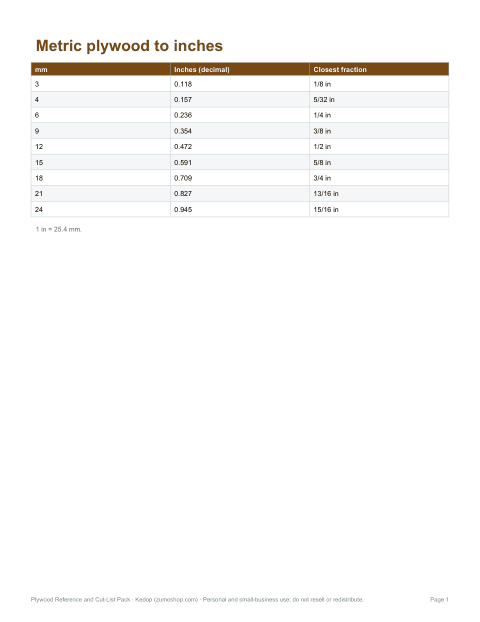
Metric plywood sizes
| Metric | Closest imperial | Typical uses |
|---|---|---|
| 3 mm (0.118 in) | 1/8 in | Craft and model plywood |
| 4 mm (0.157 in) | 5/32 in | Thin panels, backs |
| 6 mm (0.236 in) | 1/4 in | Backs, drawer bottoms, jigs |
| 9 mm (0.354 in) | 3/8 in | Light boxes, templates |
| 12 mm (0.472 in) | 1/2 in | Drawers, boxes, light shelving |
| 15 mm (0.591 in) | 5/8 in | Cabinet sides, shelves |
| 18 mm (0.709 in) | 3/4 in | Cabinets, furniture, worktops |
| 21 mm (0.827 in) | 13/16 in | Heavy shelving |
| 24 mm (0.945 in) | 15/16 in | Bench tops, flooring |
Baltic birch and many European and Asian plywoods are made in metric thicknesses with more, thinner plies and few voids, which is why they’re popular for drawers, jigs and furniture. Baltic birch is commonly sold in 5 × 5 ft (1525 × 1525 mm) sheets.
Worked example
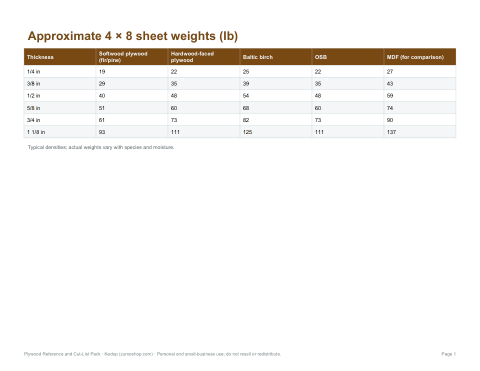
A subfloor of 320 sq ft with 3/4-inch (23/32-inch) softwood plywood and 10% waste needs 11 sheets of 4 × 8. At a typical 32 lb per cubic foot, each sheet weighs about 61 lb, so the delivery is roughly 675 lb — worth knowing for a pickup truck or a second-floor carry. For a cabinet in 18 mm Baltic birch, the same finder shows a 5 × 5 ft sheet at about 63 lb.
Span ratings and grades
Structural plywood and OSB in North America carry a grade stamp with a span rating such as 32/16 or 48/24. The first number is the maximum spacing in inches of roof supports; the second is the maximum spacing of floor joists. As a rough guide, 15/32–1/2 inch sheathing is often rated 32/16 and 23/32–3/4 inch Sturd-I-Floor panels 24 oc or 48/24, but always read the stamp on the panel you buy and follow local building codes. Appearance grades (A to D, or letter pairs such as AC) describe the face veneers: A is smooth and paintable, D allows knots and splits.
Choosing a thickness
- Cabinet boxes: 3/4 in (18 mm) for strength and screw holding; 1/2 in (12 mm) for lighter wall units.
- Cabinet backs and drawer bottoms: 1/4 in (6 mm).
- Shelves: 3/4 in for spans up to about 30 in with books; add a front edge strip for longer spans.
- Subfloor: 23/32 or 3/4 in at 16 in or 19.2 in joist spacing; 7/8 in or thicker at 24 in.
- Roof and wall sheathing: follow the span rating and code for your framing.
AI-assisted content
This chart and the templates were drafted with AI assistance and reviewed before publishing. Thicknesses and weights are typical values; products vary, and structural use must follow building codes.
Frequently asked questions
What is 1/2 plywood actual thickness?
Most 1/2 in US plywood measures 15/32 in actual thickness. That is 0.469 in, or about 11.9 mm.
How much does 19/32 plywood weigh?
Using the page’s 32 lb per cubic foot method, a 4 × 8 sheet of 19/32 in plywood weighs about 51 lb. Real sheets vary by wood species, glue, treatment and moisture, so expect a typical range around 45–60 lb.
What plywood thickness should I use for wall or roof sheathing?
Common sheathing is often 15/32–1/2 in, but thickness alone is not enough. Use the span rating printed on the panel and follow your local building code for the framing spacing.
Why is 3/4 plywood not 3/4 inch thick?
Most US plywood is made about 1/32 inch under its nominal size, so 3/4 in usually measures 23/32 in.
What is 18 mm plywood in inches?
About 0.709 in — very close to 23/32 in (0.719 in).
How much does a sheet of 3/4 plywood weigh?
Roughly 55–70 lb for a 4 × 8 softwood sheet, depending on species and moisture.
What does 32/16 mean on plywood?
Maximum roof support spacing of 32 in and floor joist spacing of 16 in.
What thickness for cabinet backs?
Usually 1/4 in (6 mm).
Is the pack a subscription?
No, it’s a one-time download.